“You always go just a little bit further than everyone else.”
A friend said that to me recently. We were talking about smart home setups — who has what, who’s planning what — and at some point he just dropped that sentence. Not as criticism. More like an observation.
And he’s right. I don’t just buy something. I google whether I could build it myself first. And if I end up buying it anyway, I check whether I can hack it.
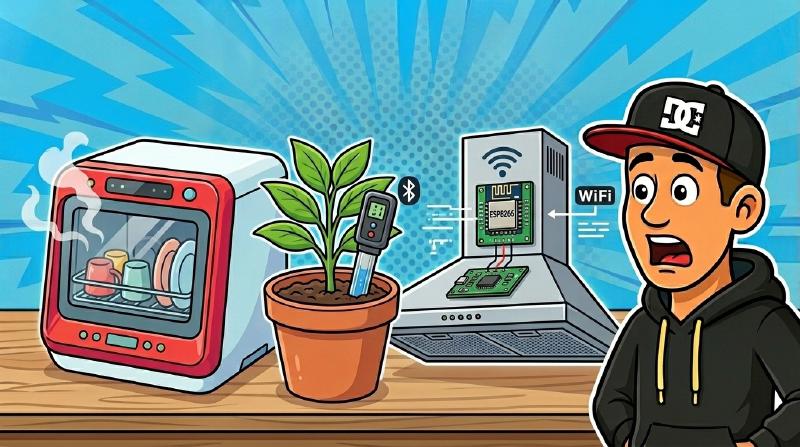
The video this article accompanies is a kind of inventory of that tendency. Three devices I actually use every day. One I had shipped to me. One I took apart eight years ago and never fully closed back up. And one I soldered myself.

The countertop dishwasher I didn’t know existed
The Blitzhome BH-CDW1 was sent to me by the manufacturer. And that’s honestly exactly why I know about it — because I would never have searched for it myself. I didn’t even know this product category existed.
A dishwasher the size of a large microwave. No fixed water connection required. Fits dishes for two to three people. And in the smart version — the BH-CDW1, about ten euros more than the base model — you also get Wi-Fi, an app, and a remaining time display.
I live alone. I didn’t have a dishwasher before because fitting one in my rented flat felt like too much hassle. This thing changed my mind. It’s quiet, fast, and I put it on the kitchen counter. No plumber, no burst pipes, no stress.
Smart home? Sort of, yes. But the real point is different: it’s the only one of the three devices you can just go out and buy. Which is exactly why it comes first.
Disclosure: This device was provided to me free of charge by the manufacturer. The review reflects my own opinion.
The range hood I haven’t touched since 2017
Now it gets more personal.
I have a problem with my range hood. Not technical — human. I forget to turn it off. On low speed it’s so quiet it disappears from my awareness entirely. I cook, I eat, I walk to the living room — and the hood keeps running silently.
By 2017 I’d had enough. I’d just started working with ESP8266 modules. I thought: there has to be a way.
The hood is a Sombra model by Gutmann. A normal device, nothing special — except for one thing: the front panel with its buttons and LEDs communicates with the control unit via a completely standard network cable. RJ45 connector. Standard cable. I simply tapped my ESP8266 in between.
The chip listens to the lines via hardware interrupt — a matrix controller running at 1000 Hz. Every button press, every LED change. And it can simulate button presses itself. Without the hood ever noticing.
The first test was — let’s call it memorable. I had everything wired up, powered it on, and then a relay clicked. And nothing worked anymore. No lights, no response, the hood completely dead.
I went to the basement, pulled the fuse, waited a minute. Restarted. Everything came back — thank god, nothing was broken.
What had really worried me: the manufacturer Gutmann no longer exists. Bankrupt for years. No spare parts, no customer service. If I’d fried the control unit, the device would have been scrap. Irreplaceable.
Since then the hood has run for eight years without a single intervention. In Home Assistant I can see the light state, the fan speed from 0 to 4, schedule it with a timer — and I get a notification when the grease filter needs cleaning. I reset the filter reminder directly from HA.
This isn’t ESPHome. It’s a manual Arduino project, compiled in VS Code, because the timing is too critical for ESPHome. Not pretty. But stable.
The full build writeup from back then: DIY IoT module for the range hood
The plant sensor you can’t buy anywhere
I stumbled across the b-parasite project on GitHub completely by accident. No company behind it, no web shop, no support. Someone designed a PCB, published the files, and the community ran with it.
I knew immediately: I want this.
You order the bare PCB from the manufacturer of your choice. You solder it yourself — an ESP8266 and a CR2032 battery holder are the most expensive components. You end up at around ten euros per sensor. Commercial plant sensors start at €20, €30 — and do half as much.
The sensor sits in the soil and measures moisture. It broadcasts over Bluetooth Low Energy — not directly to Home Assistant, that would be too far — but to my Shellys, which act as BLE gateways. The Shellys forward the data. In HA I can see the current moisture level for every houseplant.
I soldered ten of them.
The most practical thing about it: when I’m on holiday and a plant is about to die, HA sends me a notification. I message my neighbour. She comes over. Not based on gut feeling, not based on a calendar — exactly when it’s needed.
EASY, DIY, NERD — and that extra bit further
Three devices. A countertop dishwasher off the shelf. A range hood that’s been hacked for eight years. Hand-soldered plant sensors.
What they have in common: nobody in my circle of friends has any of them. And all three solve problems that nothing off the shelf solves.
My friend is right. I always go a little bit further. But that’s exactly what keeps smart home interesting for me.
What’s your quirkiest smart home device? Self-built, discovered by accident, or just absurdly practical — write it in the comments.
Note: Links marked with affiliate link are affiliate links. As an Amazon Associate I earn from qualifying purchases. This means I receive a small commission if you purchase through these links — at no extra cost to you. The revenue helps me run this blog and YouTube channel and keep creating content. Thank you for your support!
― Joachim