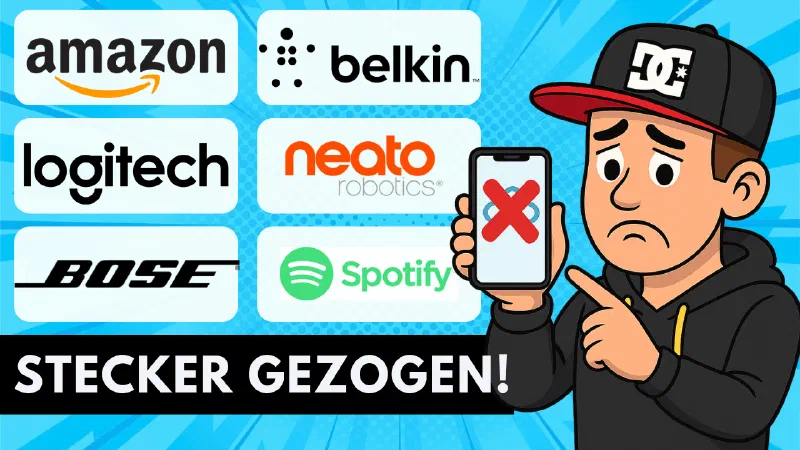
Bose shuts down the cloud, Vorwerk pulls the plug on Neato – when manufacturers pull the plug. Why this keeps happening and how you can protect yourself.
Every Smart Home Owner’s Nightmare
Imagine coming home, opening your smart home app – and suddenly it shows “No Connection.” Not because of an internet outage or a technical glitch, but because the manufacturer simply pulled the plug.
This is happening on a massive scale right now: Bose is shutting down the cloud for SoundTouch, Vorwerk is killing off Neato robot vacuums, and the list grows longer every day. Devices that cost over €1,000 are being turned into expensive paperweights overnight.
But it doesn’t have to be this way! In this video I explain why this happens and how you can protect yourself.
To load the video, please click the image. Please note that by doing so, data will be transmitted to YouTube.
Recent Cases: When Smart Homes Go Dumb
Bose SoundTouch: The €1,000 Paperweight
As of February 18, 2026, Bose is discontinuing cloud support for the entire SoundTouch product family. That means:
❌ Spotify integration is gone
❌ TuneIn radio no longer works
❌ Multiroom features are history
❌ App control is heavily restricted
Bose’s explanation: The technology has been “extensively further developed” and the company is “no longer able to maintain the cloud infrastructure.”
Translation: Running the cloud costs too much money.
Vorwerk/Neato: A Broken Promise
Even more egregious is the Vorwerk case: the company had promised five years of cloud operation for Neato robots. Did they keep that promise? Apparently not.
In 2023, Neato Robotics was shut down, and now all cloud services are being terminated. Even robots that were still sold regularly in 2023 are losing their functionality.
Vorwerk’s excuse: “Cybersecurity standards have evolved.”
The truth: They failed to invest in time – or simply didn’t want to.
The Mechanics of the Cloud Disaster
Why does this keep happening? The video explains the vicious cycle:
Phase 1: The Launch
Manufacturer develops a new product
Cloud enables modern features (remote access, updates, etc.)
Sales revenue funds cloud operation
Phase 2: Technical Progress
New device generation requires new cloud architecture
Manufacturer operates two cloud systems in parallel
Double the costs, half the benefit
Phase 3: The End
Old devices no longer sell
Cloud operation becomes a pure cost factor
Pulling the plug is the “economical” solution
Your Checklist: How to Protect Yourself
1. Check Manufacturer Reputation
Before you buy: How has the company behaved in the past?
Are there already reports of discontinued products?
How transparently does the company communicate?
Google search: “[Manufacturer] + cloud shut down”
2. Test Local Features
The most important question: Does the device work without internet?
Can you switch lights on/off during a Wi-Fi outage?
Does the robot vacuum start offline?
Does the heating control run independently?
Rule of thumb: The more features available locally, the safer you are.
3. Question Update Promises
Does the manufacturer specify support periods?
How long will updates be provided?
Are there written guarantees?
Silence is often not a good sign!
4. The Free Cloud Paradox
Warning: Free cloud services are often a red flag!
If a manufacturer only makes money from hardware sales but provides cloud services for free, that model won’t be sustainable long-term.
Better: Transparent subscription models create sustainable value for both sides.
Positive Examples: How It Should Be Done
Philips Hue: Local Foundation + Premium Cloud
Core functions: Fully local via the Bridge
Premium features: Optional via Bridge Pro (one-time purchase)
Transparency: Clear separation between free and paid
Inventory: Which of your devices depend on the cloud?
Test: Do they work offline?
Research: What is the manufacturer’s track record?
Before Your Next Purchase:
Prioritize local features
Prefer open standards (Zigbee, Z-Wave, Matter)
Support transparent business models
Long-Term:
Set up Home Assistant or a similar local system
Buy fewer cloud-dependent devices
Factor in community support when making purchasing decisions
The Bottom Line: Your Smart Home Belongs to YOU
As the Süddeutsche Zeitung aptly put it: “Anyone buying technology today is handing themselves over to the manufacturer.”
But it doesn’t have to be this way! With the right preparation and conscious purchasing decisions, you can build a smart home that belongs to you – not to the manufacturer’s cloud.
The full video walks you through everything step by step – from concrete checklists to positive examples to action recommendations for your existing setup.
Share Your Experience
What do you look for when buying smart home products with cloud features? Have you ever had a manufacturer pull the plug on functionality you relied on?
Write it in the comments – your experience helps others make better purchasing decisions!
Further Reading
You’ve reached the end of this article. Did I help you out? Did you enjoy the video? I’d be really happy if you thought it was worth €5. You can find more on the About me page.
― Joachim
Netcup is a German hosting provider I’ve been a customer of since 2011 — now with nine products (domains, web hosting, vServers and root servers). I’ve been consistently satisfied over all those years. I particularly want to highlight the reliable infrastructure, excellent support, and transparent pricing.
A real standout feature: special offers at Netcup are often permanent. That sets Netcup clearly apart from other providers where the price typically rises after the first year.