Advertising: The video for this article is sponsored by PCBWay – PCBWay paid me and covered the cost of the boards. Links to PCBWay are affiliate links. Content and opinions are my own.
I have now made my range hood smart for the second time. The first time was in 2017, with a perfboard that ran for eight years. Still, I replaced it – not because it broke, but because it turned out it never really worked properly. And because my eyes and hands just don’t cooperate with fine soldering anymore.
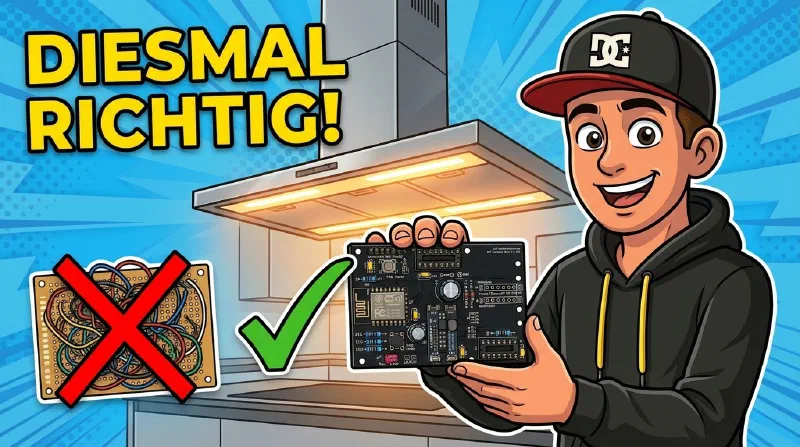
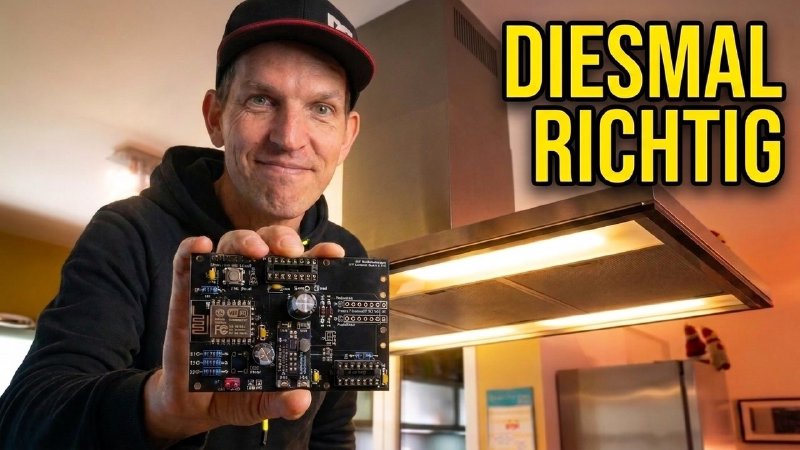
The result is my very first own circuit board: designed in KiCad, coached by an AI, manufactured by PCBWay.
The problem: the quietest range hood in the world
Our hood is quiet – on the lowest setting you simply can’t hear it. You cook, you eat, you go to the living room, and the hood keeps running, sometimes all night. We only noticed because the kitchen was cold in the morning: whatever the hood blows outside has to come back in through windows, doors and every gap. So the thing had to become smart enough to switch itself off.
2017: The hack in the cable
My hood, a Gutmann Sombra, has no interface at all – no Wi-Fi, no bus. And Gutmann is insolvent, so no spare parts. But between the control panel and the hood electronics runs a cable with an RJ45 plug. The panel itself contains no logic, just seven buttons and some LEDs. The hood scans them as a matrix: four lines are pulled high one after another for one millisecond each, and the LEDs only flash briefly – fast enough to look steady.
I figured this out in 2017 with an oscilloscope and without any documentation. The result: an ESP8266 that reads along in the hood’s rhythm and “presses” buttons at the right moment, while the original panel keeps working. Details are in my 2017 blog post (German).
Eight years – with a safety net
The circuit moved onto a perfboard in a small case inside the hood. Home Assistant switched the hood off after one hour and reminded me to clean the grease filter whenever the dishwasher started. But a watchdog automation cut the hood’s power via a Shelly about every two months, and a night-time power cut kept it from switching on by itself. Workaround after workaround.
My first KiCad project – with an AI coach
This year the hood went offline more and more often. A new perfboard attempt ended in solder bridges, so I designed a real PCB in KiCad – my first ever. Claude (Anthropic) acted as a coach: I drew and routed everything myself, Claude reviewed schematic and layout. It caught 5 V and 3.3 V shorted on the same net (the ESP8266 tolerates at most 3.6 V), explained decoupling capacitors, and helped find a wire that was half a grid point (1.27 mm) off. It was wrong sometimes too – an advisor, not an autopilot.
The mystery of the old board
The hood supplies only about 4.9 V. My old regulator wanted more, so whenever the ESP transmitted, the voltage dropped, the regulator lost control and the ESP rebooted – sometimes into a boot loop. Wi-Fi was never the problem. The fix is a TPS63802 buck-boost converter plus large buffer capacitors (1000 µF and 470 µF). All six mistakes of the old board are documented on GitHub.
Ordering, assembling, fixing
I ordered the boards from PCBWay: enter size, layers and quantity first, get a price, then upload the Gerber files in the cart; an engineer reviews them before you pay. Almost all parts are through-hole, only the ESP module is SMD – so I could solder them myself and retrofit later. That paid off: swapped matrix lines were fixed in firmware, and “ghost” button presses (floating inputs on the driver chip) were fixed with two pull-down resistors and two diodes soldered to the bottom. Revision 0.3 in the repository includes this fix but was never manufactured.
Result
⚠️ 230 V: A range hood runs on mains power, even if the control cable only carries low voltage. Before opening it, switch off the breaker and verify it is dead. More in Working safely with mains voltage.
The board sits where the old one did, and Home Assistant discovers the hood automatically via MQTT Discovery. I removed the night-time power cut on purpose – and since the rebuild at the end of September 2026, the watchdog has not triggered once.
I have 4 boards left. If you own a Gutmann hood or one built the same way, leave a comment under the video.