
Four weeks, 3,500 kilometres, a fully electric car – from Germany through Austria and Italy all the way to Croatia and back. The big question upfront: is this relaxing, or is charging on holiday pure stress? My joker in the luggage was a portable wallbox, the go-e Charger Gemini flex. Here’s what I learned about charging from strangers’ sockets along the way – including the moments when things didn’t go smoothly.
Transparency: The go-e Charger Gemini flex was provided to me by go-e free of charge as a permanent loan for this test. (Ad)
⚠️ Note from go-e: According to the operating and installation manual, the go-e Charger Gemini flex must be used hanging vertically, or mounted vertically in the included wall bracket on a flat wall. I didn’t always handle it that way on my trip; I’ve marked the relevant spots in the video. Please don’t copy this.
How this came about
A bit of backstory, because transparency matters to me: go-e didn’t come to me – I reached out to them. I’d thought the go-e Charger was genuinely great long before this. My parents-in-law have been using one for ages, though in their case the hardwired version on the wall. When the road trip came up, I figured it was the perfect match: test the portable version in real travel life for a whole month and show it here on the channel. Hard to beat that.
Which is why I was all the more pleased that go-e was completely open to supporting me – and my still fairly small channel – with the wallbox. That’s also exactly why this video isn’t a paid-for puff piece but my honest travel report: everything that worked, and the moments when it didn’t.
What actually matters: the cost
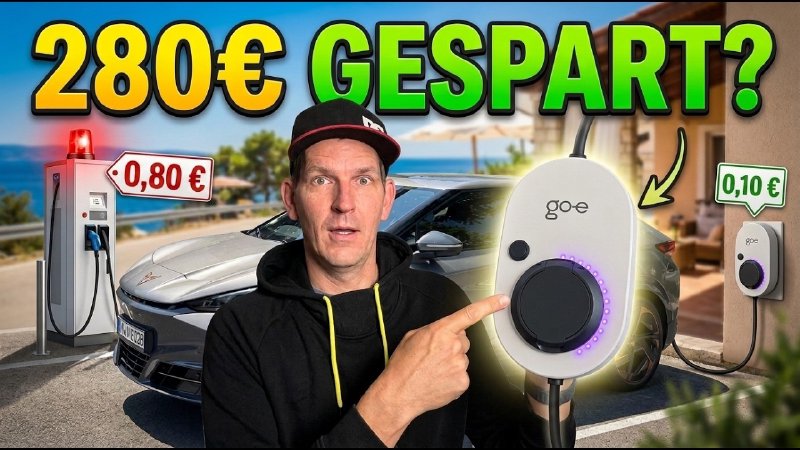
At a fast charger you quickly pay around €0.80 per kilowatt-hour on the road. At a private socket in a holiday flat, it was often just around €0.10 at night here in Croatia – and in some places the electricity was even free. EVs simply aren’t the norm there yet, and hosts are correspondingly relaxed about it.
I kept a log over the four weeks: all told, I saved over €280 compared to what fast charging would have cost. Over an entire holiday, that’s a real difference.
Charging from an unknown Schuko socket: how many amps are safe?
The most common case on the road is the ordinary household socket – the Schuko. The immediate question is how much current you can reasonably draw from it.
go-e recommends 6 amps for unknown sockets. That’s the safe bet – but on my Cupra Tavascan (77 kWh) it means roughly 33 hours from 20 to 80 percent. The full 16 amps you should never draw continuously from a normal Schuko: it isn’t built for that and can overheat over time.
I wanted to know for sure and had my thermal camera with me:
- First flat, overnight at 10 A: 6 A brought the socket to about 25 °C, 10 A to around 30–35 °C – both perfectly fine.
- Second flat, even at 12 A – but there was a dedicated Schuko with its own fuse and RCD, mounted in the garage specifically for the car.
Rule of thumb without a thermal camera: if you touch the Schuko plug after an hour and it’s hot, something is wrong – dial the charging power right back.
I show what Schuko charging looks like in thermal view as one of five use cases in the thermal camera video.
More than Schuko: the adapter set
Schuko isn’t everything. The go-e Charger comes with an adapter set of three adapters, and that’s what makes the box truly flexible:
- Schuko adapter for the normal household socket.
- Blue camping plug (blue CEE) – familiar from campsites, found almost everywhere there, and rated to deliver 16 A continuously.
- Red CEE adapter for industrial power sockets. Important: not every red socket is the same – some are for 11 kW, some for 22 kW, and they differ in size. That’s what the red-to-red adapter in the set is for.
Control via the app – local, no cloud
The box is controlled through the go-e app. The nice part: it opens its own Wi-Fi hotspot – you need no internet and no cloud, everything runs locally.
One pitfall cost me some nerves early on: your phone has to be on the box’s Wi-Fi, otherwise the app can’t find the box. If you’re also in range of the holiday flat’s Wi-Fi with internet, the phone happily prefers that one – and the box is “gone”. When in doubt, quickly check which network your phone is actually on.
A word on the charging log, in case you want to settle up with your host: the box does keep a log, but on the road it has no network and therefore no date or time. For our billing we simply used the car’s charging log instead.
Safety & practical details
- LEDs can be switched off – handy when charging in a publicly accessible car park where you don’t want the box drawing attention at night.
- Cable locking at the box – so a spontaneous theft isn’t easy.
- Built-in RFID reader: you can set the box to charge only after authorisation with the included chip.
- Unplugging order: always pull the Schuko plug only once charging has stopped. The Type 2 plug at the car is locked and built to be disconnected under load – the Schuko isn’t. Pull it under load and you get small arcs that can destroy the socket over time.
The glitch in Split
Of all places, at the dedicated socket in Split the charge stopped abruptly one night – the go-e app said “phase not available”. First thought: is the box broken? It wasn’t. At the same time there was a heavy thunderstorm and a brief power cut. I only noticed because the car automatically pushed a notification to my phone. Restarted the charge, everything ran normally again.
The lesson: if a charge cuts out, don’t immediately blame the box – often the power source is the culprit.
Too bulky for travel? The dual benefit
Yes, the box is bigger than a plain charging cable. But the point is: you only need one wallbox. At home, have an electrician fit a blue or red CEE socket and run the box on its included wall bracket as a fixed installation. When you head off on holiday, unplug it and take it along. No second purchase.
Verdict
Does a portable wallbox pay off for travellers? After 3,500 kilometres, a clear yes for me. I was independent of public charging infrastructure at every stop, charged far more cheaply and could top the car up overnight – almost like at home. There are a few things to keep in mind, but comfort and savings combined won me over.
If you want to take a closer look at the go-e Charger Gemini flex, you’ll find it on Amazon in the 11 kW version* (the one I used) and the 22 kW version, plus the matching adapter set.
* Links marked with an asterisk are affiliate links. As a partner I earn from qualifying purchases – at no extra cost to you.